
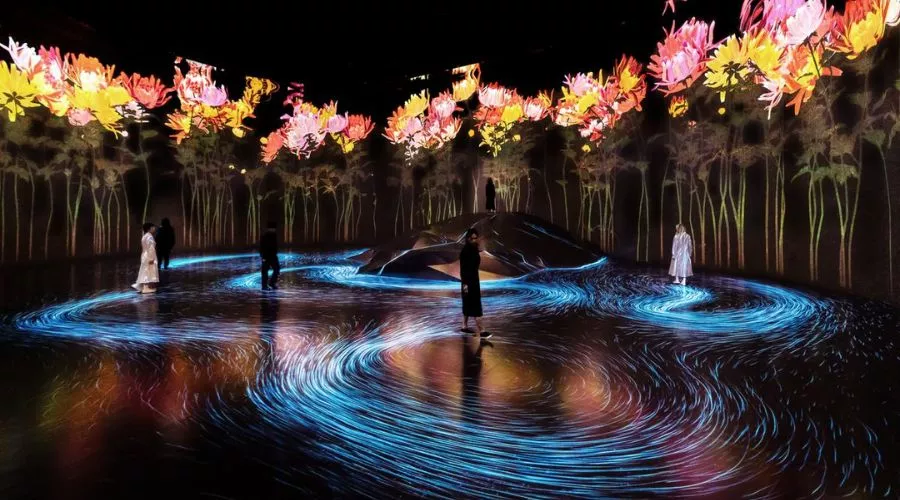
Digital art exhibitions have transformed the way creativity is experienced, shifting audiences from passive viewers to active participants inside ever-evolving visual worlds. Powered by advanced technology, these exhibitions blend light, sound, motion, data, and interactivity into vast sensory environments that expand beyond the limits of canvas and sculpture. What began as a niche experiment has now become one of the most influential forces shaping contemporary creative culture.
Unlike traditional gallery displays, digital exhibitions surround visitors with shifting visuals, responsive sound, and real-time interaction. Entire rooms become the artwork. Walls dissolve into glowing forms. Floors ripple with moving patterns. Light behaves like liquid. Sound follows movement. Every step alters the environment, making each visit a singular experience that cannot be duplicated.
The Evolution of Digital Art Exhibitions
The roots of digital art can be traced to early computer experiments, when artists began exploring pixels, algorithms, and motion graphics as creative tools. At first, the limitations were significant—low resolution, slow processing, and minimal interactivity. Over time, technological advances removed these barriers and unlocked vast new creative possibilities.
As projection systems grew brighter and more precise, artists could fill massive spaces with moving visuals. Motion sensors made interaction possible. Real-time rendering allowed environments to evolve based on human behavior. Artificial intelligence enabled artworks to respond intelligently rather than predictably.
Today’s digital exhibitions represent the convergence of multiple disciplines: visual art, sound design, programming, architecture, physics, and psychology. This fusion allows artists to build experiences that evolve moment by moment, shaped by both software and human presence.
What Defines a Digital Art Exhibition
A digital art exhibition is defined by technology functioning as the primary creative medium. Instead of pigment, stone, or metal, the artist works with:
- Projection mapping
- Real-time animation engines
- Sensor-driven interaction
- Algorithmic systems
- Virtual and augmented environments
- Data visualization
- Artificial intelligence
These elements come together to form installations that continuously shift and adapt. There is no fixed final version. The artwork exists in a state of constant transformation, influenced by lighting, sound, audience movement, and even live data feeds.
This fluid nature makes digital art fundamentally different from static displays. The exhibition evolves throughout the day, creating endless variations within a single creative framework.
Immersive Projection Environments
One of the most powerful forms of digital art exhibition is the immersive projection environment. These installations transform entire rooms into flowing visual landscapes. Floor-to-ceiling projections, wraparound walls, mirrored ceilings, and spatial audio systems combine to eliminate physical boundaries.
Visitors walk through galaxies of light, liquid color fields, digital forests, abstract geometries, or dreamlike architectural structures. The visuals move in harmony with sound, creating emotional rhythms that guide movement and perception.
These environments often operate in synchronized cycles, shifting mood from calm to dramatic within minutes. The result is not only visual stimulation but emotional immersion that feels almost physical.
Interactive Digital Installations
Interactivity lies at the heart of modern digital exhibitions. Sensors track movement, gestures, and position, allowing the artwork to respond directly to human behavior. Every visitor becomes a creative force within the system.
A step forward may cause waves of light to ripple outward. A raised hand might summon floating shapes. A pause in motion may cause the entire environment to slow and fade.
This relationship between human and machine creates a dialogue. The artwork reacts, and the viewer responds in return. The experience becomes deeply personal, shaped by curiosity, timing, and movement. No two visitors ever experience the same version of the exhibit.
Virtual Reality in Exhibition Spaces
Virtual reality adds another dimension to digital exhibitions by transporting visitors into fully simulated environments. Wearing headsets, participants step into boundless creative worlds where gravity, scale, and perspective behave in unfamiliar ways.
Within these environments, visitors may float through abstract data landscapes, navigate endless corridors of shifting geometry, or interact with evolving virtual organisms. Unlike traditional digital displays, virtual reality removes the physical room entirely and replaces it with infinite digital space.
This medium allows artists to explore themes of identity, memory, time, and perception in ways that cannot exist in physical form alone.
Augmented Reality as a Creative Layer
Augmented reality brings digital elements into physical environments. Instead of replacing the physical world, it enhances it with invisible creative layers revealed through devices or wearable displays.
A blank wall may reveal animated patterns. A sculpture may project evolving stories. A public square may become a dynamic canvas filled with floating digital organisms.
The power of augmented reality lies in its ability to transform everyday architectural spaces into adaptive exhibition zones without permanent alteration. Entire environments become potential creative surfaces.
The Role of Artificial Intelligence
Artificial intelligence has become one of the most transformative tools in digital art exhibitions. Algorithms analyze real-time data such as movement patterns, sound input, environmental conditions, or audience engagement, using this information to generate evolving visuals and soundscapes.
In these exhibits, the artwork behaves almost like a living system. It learns from interaction, adapts to behavior, and changes over time. This removes predictability and allows creative environments to develop unique personalities shaped by accumulated audience presence.
Artificial intelligence also challenges traditional ideas of authorship. The artist builds the creative framework, but the system itself continuously generates variations beyond manual control.
Sound as a Core Artistic Element
Sound is not a secondary feature in digital exhibitions—it is structural. Spatial audio systems create directional sound movement that guides the body and shapes emotion.
Low-frequency vibrations create physical sensation. Soft ambient layers encourage calm. Rapid rhythmic patterns elevate energy. Sudden silence generates tension. The soundscape reacts to movement just as visuals do, forming a synchronized sensory language.
Many installations behave like living instruments, where the audience unknowingly composes music through motion and presence.
Digital Art as a Cultural Mirror
Digital exhibitions often explore complex social, philosophical, and environmental themes. Artists use technology to reflect modern realities shaped by data, automation, climate transformation, surveillance, and interconnected networks.
Common thematic explorations include:
- Human identity within algorithmic systems
- The emotional cost of constant connectivity
- Environmental fragility and digital simulation
- The balance between organic nature and artificial structures
- Memory creation in virtual environments
- Surveillance, data collection, and personal autonomy
Because many works react in real time, they become dynamic reflections of living systems rather than static statements.
Accessibility and Inclusivity in Digital Exhibitions
One of the most powerful advantages of digital art exhibitions is their accessibility. These experiences remove many traditional barriers related to language, academic knowledge, or artistic training.
Visual motion, sound, and interaction require no translation. Visitors intuitively understand how to engage simply through movement and observation.
Virtual platforms also allow remote access to exhibition environments, making participation possible regardless of location. Sensory-based navigation further supports individuals with different mobility needs or communication styles.
Digital exhibitions democratize creativity and open participation to broader audiences than traditional gallery models.
Emotional Impact and Psychological Engagement
Digital environments influence emotional states through controlled light intensity, sound frequencies, spatial scale, and movement rhythm. Bright, expansive visuals evoke awe. Soft oscillating patterns induce calm. Rapid strobing motion heightens intensity.
These sensory combinations activate deep emotional responses. Many visitors describe digital exhibitions as meditative, overwhelming, euphoric, introspective, or transformative.
Because the artwork responds to movement, the viewer feels directly responsible for changes in emotional atmosphere. This sense of agency deepens psychological engagement and memory formation.
Sustainability and Digital Creativity
While digital exhibitions rely on advanced technology, many artists integrate sustainability into both concept and execution. Energy-efficient projection systems, low-heat lighting, recyclable materials, and data-driven simulations addressing environmental concerns increasingly define responsible digital practice.
Some exhibitions visualize climate data, water systems, deforestation, or atmospheric patterns, turning invisible environmental processes into visible artistic experiences. This fusion of creativity and ecological awareness adds educational depth to the immersive spectacle.
Digital Exhibitions as Social Spaces
Unlike traditional galleries where silence dominates, digital exhibitions encourage movement, conversation, collaboration, and shared discovery. Visitors explore together, react to shifting environments collectively, and influence installations as a group.
The shared experience becomes social as much as artistic. Strangers observe each other’s influence on the artwork. Moments of surprise, confusion, and delight spread across the room. The exhibition becomes a living social system shaped by collective behavior.
The Future of Digital Art Exhibitions
The future of digital exhibitions lies in deeper integration between physical reality and virtual systems. Developments in artificial intelligence, wearable interfaces, neural input technology, and real-time global data will allow creative environments to adapt in increasingly complex ways.
Future exhibition spaces may respond to emotional signals, biometric data, brainwave activity, or environmental fluctuations in real time. Art will no longer be viewed alone—it will be felt, altered, and co-created at the level of thought and sensation.
As these technologies mature, the border between physical and digital creativity will continue to dissolve.
Conclusion
Digital art exhibitions represent one of the most powerful creative revolutions of the modern era. By merging technology with imagination, these experiences transform how art is created, shared, and felt. They replace fixed objects with evolving systems, passive viewing with participation, and static perception with dynamic immersion.
Through projection environments, interactive installations, virtual worlds, algorithmic systems, and responsive soundscapes, digital exhibitions open new creative dimensions that extend beyond physical limitations. They reflect cultural realities, emotional complexity, environmental awareness, and the evolving relationship between humanity and intelligent systems.
